Chris Curl,
Editor
Dec. 4, 2025
Charlie Munger must be spinning in his grave as Bitcoin’s last big holdout finally gives in.

Vanguard’s decision to open its doors to Bitcoin and other crypto ETFs is one of the biggest, and most surprising, turnarounds I’ve seen in finance.
After almost two years of digging in its heels, the world’s second-largest asset manager reversed its anti-crypto stance on December 2, 2025. Overnight, 50 million brokerage customers with more than $11 trillion under management gained access to regulated Bitcoin, Ethereum, Solana, and XRP ETFs.
What makes this so remarkable is that Vanguard wasn’t just “reluctant” about crypto, it was philosophically opposed. This is a firm built on Jack Bogle’s deeply conservative investment principles. For decades, anything resembling speculation was treated as radioactive. So for Vanguard to do a full 180? That tells us something massive is shifting.
This reversal exposes three unstoppable forces reshaping the financial world:
- Spot Bitcoin ETFs have been too successful to ignore.
- Younger, wealthier investors were leaving platforms that didn’t offer crypto.
- A crypto-savvy former BlackRock executive took over as CEO and changed the culture.
Together, those pressures pushed Vanguard to admit what much of Wall Street already realized: crypto isn’t going anywhere.
Vanguard’s Fortress of Conservative Investing
Vanguard’s resistance was based on ideology.
Jack Bogle built the firm on extremely simple principles:
- Buy assets that generate cash flow.
- Keep costs microscopic.
- Avoid speculation.
- Stick to broad, long-term index funds.
Under that philosophy, Bitcoin was essentially public enemy number one:
No cash flows.
High volatility.
Speculative.
So when spot Bitcoin ETFs got SEC approval in January 2024, Vanguard didn’t just avoid launching its own. It blocked all crypto ETFs entirely, including those from BlackRock and Fidelity. Clients trying to buy Bitcoin ETFs on Vanguard’s platform ran into error messages, and social media exploded with #BoycottVanguard.
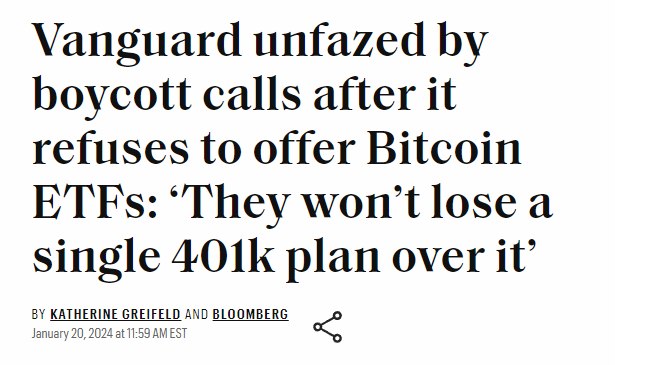
Former CEO Tim Buckley only dug in deeper. In March 2024, he said the firm wouldn’t budge “unless the asset class changes,” calling Bitcoin too volatile and not a store of value.
Vanguard even removed Bitcoin futures ETFs, repeatedly argued that crypto had no inherent value, and positioned itself as the last principled holdout while every major competitor: Schwab, Fidelity, Morgan Stanley, offered crypto access.
The Bitcoin ETF Boom That Vanguard Couldn’t Ignore
Ultimately, the numbers made denial impossible.
Spot Bitcoin ETFs didn’t just succeed—they became one of the fastest-growing investment categories in U.S. history.
BlackRock’s IBIT was the star:
- Hit $70 billion AUM in just 341 days
- Became the fastest-growing ETF ever
- Generated an estimated $245 million in annual fees
- Became BlackRock’s most profitable product line
Across the entire sector:
- Spot Bitcoin ETFs: $120B AUM, with $57.7B in net inflows
- Ethereum ETFs: $20–24B
- Solana ETFs: $605M
- XRP ETFs: $756M
- Global Bitcoin ETF market (mid-2025): $179.5B
This wasn’t speculative chaos—it was orderly, liquid, and institutional-grade.
And it wasn’t just retail:
- Harvard’s endowment held $443M of IBIT
- BlackRock’s own funds increased their IBIT positions
- ETFs remained stable during a 28% Bitcoin pullback
This was undeniable proof that crypto ETFs had matured. Vanguard’s total blackout was becoming impossible to justify.
Clients Were Leaving… Fast
If market success was the carrot, client defection was the stick.
A November 2025 Zerohash survey of affluent young investors found:
- 35% moved assets away from advisors who didn’t offer crypto
- Among those making $500k–$1M annually, that jumped to 51%
- Over half moved between $250k and $1M per transfer
This wasn't a minor frustration. This was a generational exit.
More importantly:
- 76% of affluent crypto investors manage their own exposure
- 84% plan to increase crypto allocations
- 92% want access to more than just BTC and ETH
Vanguard’s ban forced many clients to split portfolios—traditional assets at Vanguard, crypto assets elsewhere—creating tax headaches and operational inefficiencies. Advisors routed crypto trades to other brokerages, and relationships gradually shifted away.
Industry experts initially mocked #BoycottVanguard… but that was before the long-term erosion became obvious.
The Leadership Shift That Changed Everything
The real turning point was the CEO transition.
In July 2024, Vanguard appointed Salim Ramji the first external CEO in its history. And not just any outsider: the guy who built BlackRock’s iShares Bitcoin ETF strategy.
At BlackRock, Ramji:
- Oversaw the launch of IBIT
- Managed the majority of BlackRock’s client assets
- Expanded ETFs into retirement and wealth portfolios
- Had deep crypto and ETF experience
Still, even he didn’t flip the switch immediately. In August 2024, he publicly said Vanguard had “no plans” to offer crypto ETFs. It took more than a year for internal resistance to break down.
By December 2025, the combination of:
- Relentless ETF inflows
- Client outflows
- Clear operational maturity
- Industry-wide shifts
… finally led to the policy change.
How Big This Really Is
Vanguard opening its platform is potentially massive for crypto.
Even tiny allocation percentages create huge flows:
- 0.1–0.2% allocation = $11–22 billion
- 1–4% allocation (typical institutional recommendation) = $110–$440 billion
- Current spot Bitcoin ETF market = $120B
That means Vanguard alone could 3–4x the entire market.
And unlike hedge funds, Vanguard investors:
- Rebalance methodically
- Hold long-term
- Don’t chase price action
A typical allocation like “60/40/1” (stocks/bonds/crypto) would mean:
- Automatic buy-the-dip behavior
- Stickier, less reactive capital
- Higher long-term price floors
Analysts project:
- $2.5–3B in new inflows by March 2026
- $30B+ in annual passive inflows once fully adopted
- 100+ new crypto ETFs launching in the next six months
Vanguard’s participation is a distribution unlock for the entire industry.
Why This Moment Really Matters
This is the moment crypto fully enters the financial mainstream.
Vanguard was the final true ideological barrier. The last big institution saying “Bitcoin doesn’t belong in a long-term portfolio.” When that institution flips, it sends a clear message:
Crypto has graduated from “speculative experiment” to “standard asset class.”
We’ve now reached the point where:
- Government regulators have set clear rules
- Crypto ETF structures are battle-tested
- Custody (especially via Coinbase) has proven durable
- Major banks and brokerages now recommend allocations
Vanguard still isn’t launching its own crypto ETFs (just like it doesn’t run gold funds), and it won’t touch meme coins. But allowing access is enough to reshape the investing landscape.
Wall Street’s Full-Scale Crypto Embrace
Vanguard’s reversal lands during a huge year for institutional adoption:
- Bank of America will start recommending 1–4% crypto allocations in 2026
- JPMorgan, Morgan Stanley, Citi, Visa, and Mastercard now offer crypto products
- PayPal and Shopify are building crypto payment rails
- U.S. crypto ETPs: 76 products, $156B AUM
- Global volume growth:
- North America: 49%
- Europe: 42%
- Market cap: $3.18–$3.24T in late 2025
Crypto went from niche to global infrastructure in under five years.
With Vanguard finally opening the gates, the last major obstacle to mainstream crypto adoption is gone. Tens or even hundreds of billions in new demand could enter the market over time, much of it from long-term, price-agnostic investors.
Whether crypto ultimately fulfills its grand promises is still an open question, but one thing is now certain:
The debate has officially moved from the fringes of finance to the very center.
Don’t miss out on crypto’s mainstream moment.
Keep coming back,

Chris Curl
Editor, Daily Profit Cycle