Chris Curl,
Editor
March 12, 2026
Washington is quietly running a live‑fire experiment in perverse incentives, and Spokane is ground zero.
The pattern is simple: when productive people try to lower costs, restore order, or improve basic conditions, the state’s institutions swat them down.
But when it’s time to tax, regulate, and reward dysfunction, suddenly anything goes.
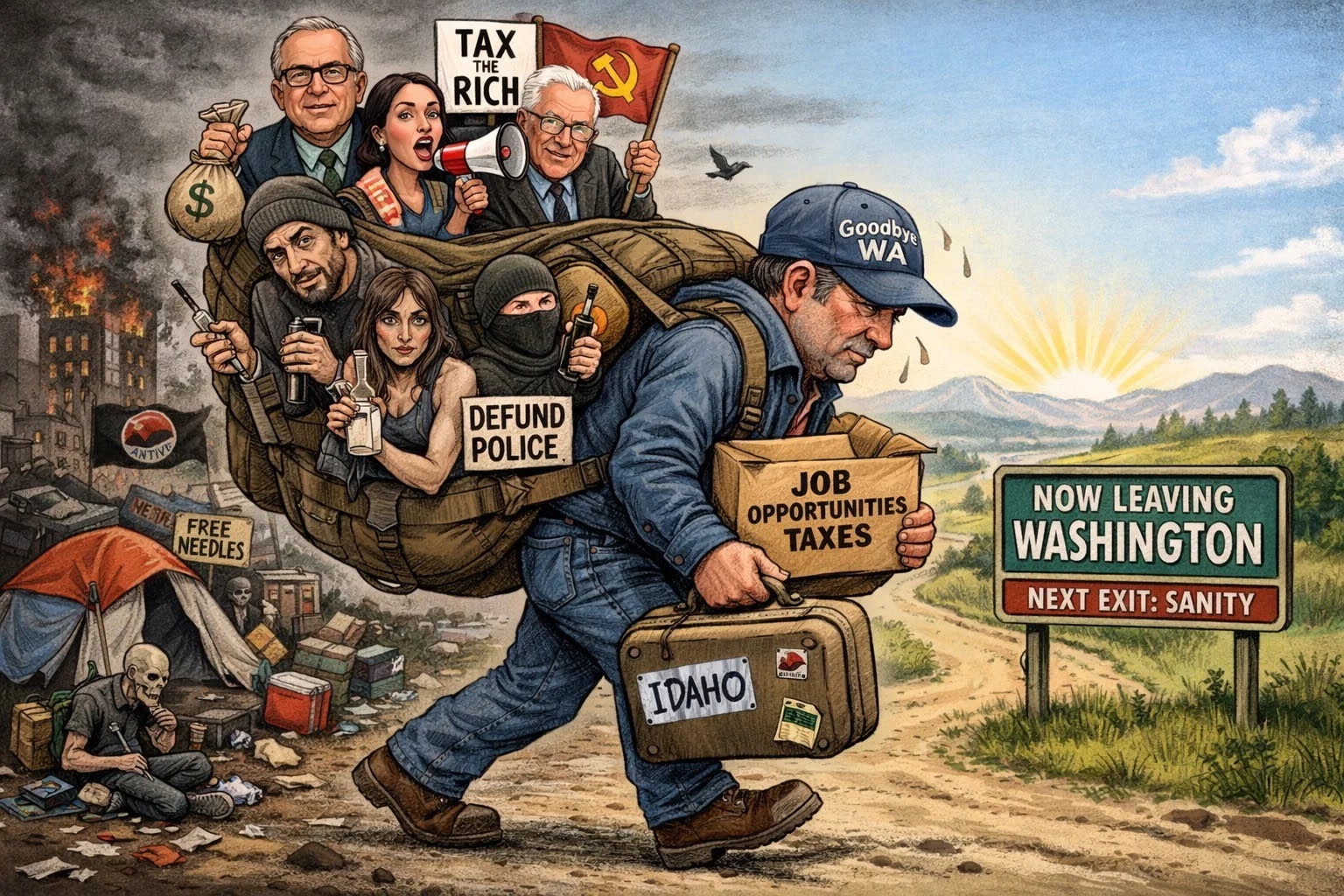
$30 tabs: voters asked for relief, Olympia said no
Start with the $30 tabs. In 2019, Washington voters passed I‑976, a statewide initiative to cap most car‑tab fees at $30 and unwind a web of local add‑ons that had turned vehicle registration into a regressive, opaque tax.
Whatever you think of Tim Eyman, that vote was a clear expression of “enough,” especially from working families and commuters who don’t have the luxury of living car‑free in downtown Seattle.
In 2020, the Washington Supreme Court struck I‑976 down on technical constitutional grounds. The legal reasoning may please purists, but the incentive signal is brutal: when voters try to lower broad‑based costs in a perfectly legal way, the system closes ranks to preserve the revenue. There was no comparable urgency to simplify fees, rebuild trust, or deliver obvious value for the dollars already being extracted.
For tech and finance professionals, this looks like a one‑way ratchet: taxes and fees are sticky on the way up, but citizen‑led efforts to ratchet them down are fragile and easily reversed.
Covid lockdowns: compliant actors as shock absorbers
Then came Covid. Washington rolled out some of the strictest “Stay Home, Stay Healthy” measures in the country: non‑essential businesses shuttered, indoor dining banned, churches and gyms closed, gatherings tightly limited.
Those restrictions persisted in various forms deep into 2021, long after it was clear which environments were truly high‑risk and which were not.
On the ground, rule‑following small businesses, landlords, and employees became the shock absorbers. They closed on command, paid rent and taxes anyway, and got capacity limits, arbitrary phase systems, and shifting guidance in return.
Meanwhile, institutional players (large tech platforms, government agencies, hospital systems) came through relatively stronger, benefiting from captive demand, stimulus, and their ability to negotiate bespoke exceptions.
The lesson for a mobile engineer or founder is straightforward: in a crisis, the state will happily offload economic pain onto the most compliant and least connected actors.
That’s not the kind of risk you want to underwrite with your career or your cap table.
Spokane’s camping ban: 75% of voters vs. the court
Now zoom into Spokane. I live here; I’ve watched the streets change in real time.
For years, we tolerated encampments and street disorder that would have been unthinkable a decade ago. Residents and businesses paid their property taxes, followed zoning rules, and watched basic order erode… needles in parks, vandalism, open‑air drug use, encampments near schools and playgrounds.
In 2023, Spokane finally pushed back. Proposition 1 was simple: ban camping within 1,000 feet of schools, parks, and licensed childcare facilities. It wasn’t a fringe measure; roughly three‑quarters of Spokane voters (about 75%) approved it.
In a polarized country, that kind of bipartisan consensus on anything is rare. It was a city saying, decisively, “Kids and public spaces come first.”
In April 2025, the Washington Supreme Court struck Prop 1 down.
The majority didn’t argue that safe school zones were immoral; instead, they said voters had overstepped the local initiative power by “administering the details” of policy rather than enacting a new law.
On paper, that may sound tidy. On the street, it felt like this: 75% of local voters tried to restore basic order around schools and parks, and the state told them they weren’t allowed.
If you’re a founder or investor looking at Spokane as a potential second‑tier tech hub, what do you see? A community that actually mustered overwhelming consensus to protect kids and public spaces and a state‑level judiciary that invalidated it on a procedural technicality.
You learn that even when locals do the “right” thing, their preferences are subordinated to statewide ideological battles.
From “no income tax” to capital‑gains and millionaire taxes
Layer on the tax story. Washington’s secret weapon for decades was simple: no personal income tax. That’s a big reason the state attracted an outsized share of high‑earning tech workers, founders, and investors.
That edge is fading. The state has already imposed a tax on certain long‑term capital gains, upheld by the courts by re‑labeling it an “excise” tax rather than an income tax, despite the fact that it plainly targets individuals’ realized investment gains.
And just this week, lawmakers approved a “millionaires’ tax,” effectively imposing Washington’s first direct income‑style tax on high earners. On top of that, a wealth tax on ultra‑high‑net‑worth residents has been seriously floated, sending an unmistakable message to founders and investors watching from the sidelines.
At the same time, some of the state’s highest‑profile residents have moved to low‑tax jurisdictions. You don’t need a PhD in public finance to connect the dots: if you keep layering on experimental taxes aimed squarely at capital gains and wealth, the people who generate those gains and hold that wealth will start to leave.
The incentive structure for tech and capital
Viewed from 30,000 feet, Washington is sending a clear message to the most mobile, high‑productivity people in its economy:
- When you ask for lower broad‑based costs (like $30 tabs), the system finds a way to say no.
- When you comply with emergency rules, you absorb most of the economic damage while politically connected institutions are buffered.
- When your community musters overwhelming support to clean up basic public‑safety failures (Spokane’s Prop 1), state‑level actors invalidate it on technical grounds.
- When it’s time to tax your capital gains, high incomes, and potentially your net worth, constitutional limits suddenly become flexible.
That is the definition of a perverse incentive structure. The worst behaviors (street‑level disorder, policy failure, fiscal bloat) are insulated. The best behaviors (building businesses, investing, complying, voting, trying to fix your city) are taxed, regulated, or vetoed.
The rich and productive always have options.
The tech workforce is the most mobile workforce on earth: a senior engineer, product lead, or quant can move to a low‑tax state with a few months’ planning. Founders can choose where to domicile their next company and where to recognize liquidity events. Capital allocators can decide whether to scale staff and operations here or somewhere their after‑tax risk/reward calculus isn’t deteriorating.
Washington doesn’t have to become the worst place for high‑skill talent; it only has to become materially worse than the alternatives. Right now, between judicial hostility to voter‑driven reform, aggressive experimentation with high‑earner and capital‑gains taxation, and a demonstrated willingness to use compliant small actors as crisis shock absorbers, the state is burning down the very edge that built its tech boom.
Of course, all of this is just a microcosm of what’s happening on a broader scale across America and the West. Destructive agendas are being advanced against the will of the people causing many to question whether we live under a democratic system at all.
The future likely lies in decentralized systems (like blockchain) and more local community structures that are able to self-govern and insulate themselves from the increasingly authoritarian hand of the State.
Keep coming back,

Chris Curl
Editor, Bizarro World