Nick Hodge,
Publisher
Jan. 13, 2026
The precious metals continue to break records.
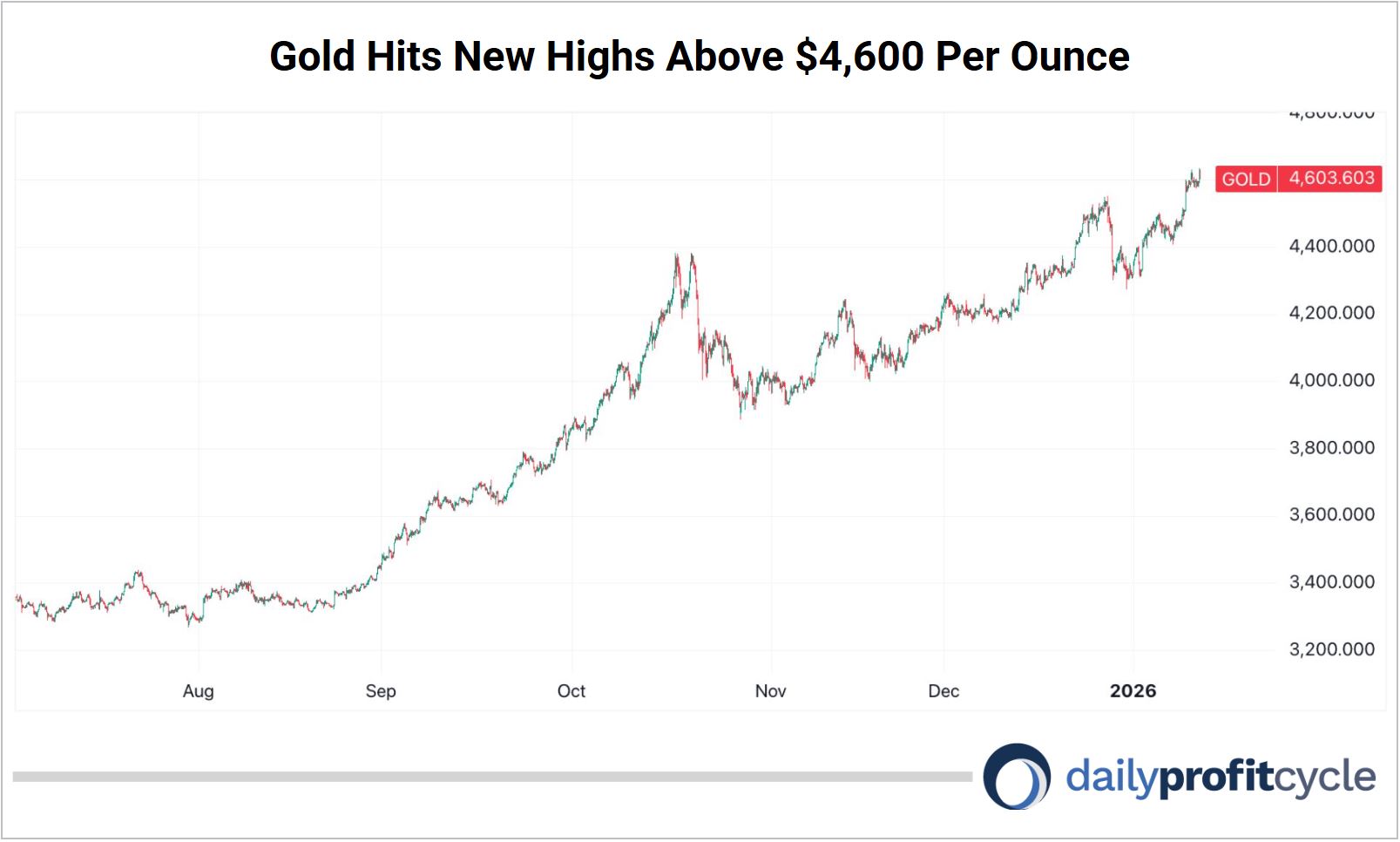
Gold touched new all-time highs near $4,550 per ounce toward the end of December before slipping down to $4,315 to finish out 2025.
The one-day fall of ~$200 on December 29 was hardly a consolidation of recent gains, but the price has nonetheless marched to new all-time highs above $4,600 on geopolitical uncertainty headlined by US-backed regime change in Venezuela that saw the overnight ousting of Nicolas Maduro.
Silver continues to lead the way, first breaking higher than gold amid Trump tariff announcements in July, and further separating itself after the entire metals sector corrected in October.
On October 21, gold and silver were neck and neck year-to-date for 2025, up 65% apiece. By the end of the year, gold was up that same 65%, but silver had surged 148% and had touched the $80 level. It’s now approaching new highs near $90 per ounce.
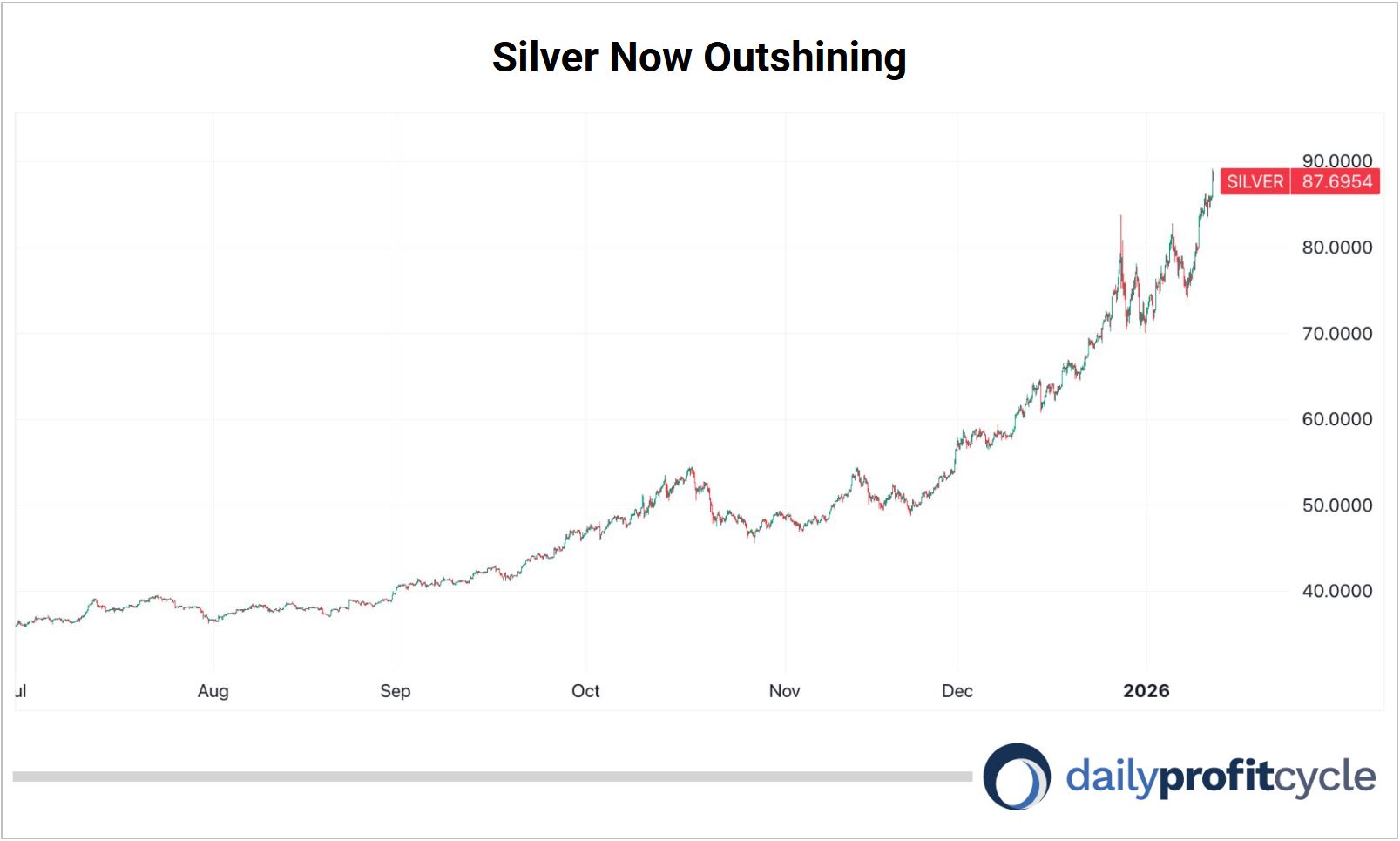
I’ll spare you the ink on central bank buying, industrial demand, and the retail crowd getting involved. The moves we’re now seeing are more structural, with the silver price putting in unprecedented $7 to $10 daily swings.
This shows gold and silver aren’t rising just because of inflation, central banks, falling yields, debt, a weak dollar or any of the other oft-cited reasons. These recent moves have more to do with the paper market showing signs of tears.
In markets like the COMEX and London Metal Exchange, most gold and silver trading is paper-based — futures, forwards, swaps, etc. And for decades, bullion banks sold far more paper gold and silver than physical metal that actually exists.
Estimates often cited by critics of paper markets say that 50–100 paper claims exist for every single ounce of real metal. This worked because almost nobody asked for delivery. Trades were settled in cash. The result was paper selling keeping prices artificially suppressed.
What’s changed recently is more buyers now demanding physical delivery rather than cash settlement. And it seems bullion banks can’t source enough real metal to meet those claims. That forces banks to buy back shorts — at any price. It’s a classic short squeeze. If true, the moves we’re seeing in the precious metals market mean that:
- Shorts are trapped;
- Physical supply is tight; and
- Paper pricing no longer controls the market.
The thinking is that because physical prices in Shanghai and India are much higher than paper prices in New York and London, traders are buying cheap paper-linked metal in the West and shipping physical metal East for higher prices, thereby draining physical metal from Western vaults and exposing how little is actually available.
The contrarian — or conspiracy theorist, depending on who’s listening — would say that paper gold and silver markets, with their 50- or 100-to-1 bloat, were used to protect confidence in the U.S. dollar, support government bond markets, and suppress monetary alternatives. Physical delivery is pulling back the curtain on the wizardry and leading to a yellow- and silver-brick road of real price discovery.
More plainly, gold and silver are surging because the world is calling the bluff on paper metals, forcing a physical short squeeze that exposes how little real metal exists behind decades of IOUs.
The paper gold and silver markets can support confidence in the dollar and government bonds by suppressing the monetary warning signal that rising precious metal prices normally send. At least until physical delivery forces the system to reprice reality.
With reality now being repriced, we’re moving from a cyclical bull market into a structural one.
That same psychology is spilling over into other metals, with traders, investors, institutions, and maybe even your cousin or nephew now talking about the need for more physical metal be it gold, silver, platinum, palladium, copper, or even lithium.
Prices are now reflecting this new reality with three-month prices for:
- Platinum up ~50% to all-time highs north of $2,400/oz;
- Palladium up ~40% to $1,850/oz;
- Copper up ~16% to all-time highs north of $6.00/lb;
- Lithium Carbonate up ~80% to over $18,000, back in a bull market;
And others, like tin and nickel, on the move higher as well.
See one of the main ways we’re profiting in this video about “Gold Scripts.” We’re buying companies that own these special contracts, allowing them to achieve leveraged gains to the price of the metals.
Plus see why an event on January 19th could multiply the gains even further.
History has proven this group of stocks to outperform during entire cycles.
Call it like you see it,

Nick Hodge
Publisher, Daily Profit Cycle